



The 2025 EAEPE William Kapp Prize went ex aequo to (1) Bakou Mertens for his paper When shareholder power kicks in: corporate financialization as ratchet behaviour and sticky payouts published in the Socio-Economic Review, and (2) Paschalis A. Arvanitidis & George Papagiannitsis for their paper Community and informal institutions in reforms under crises: the odyssey of a 350-year-old functionally credible water commons paper published in the Journal of Institutional Economics.
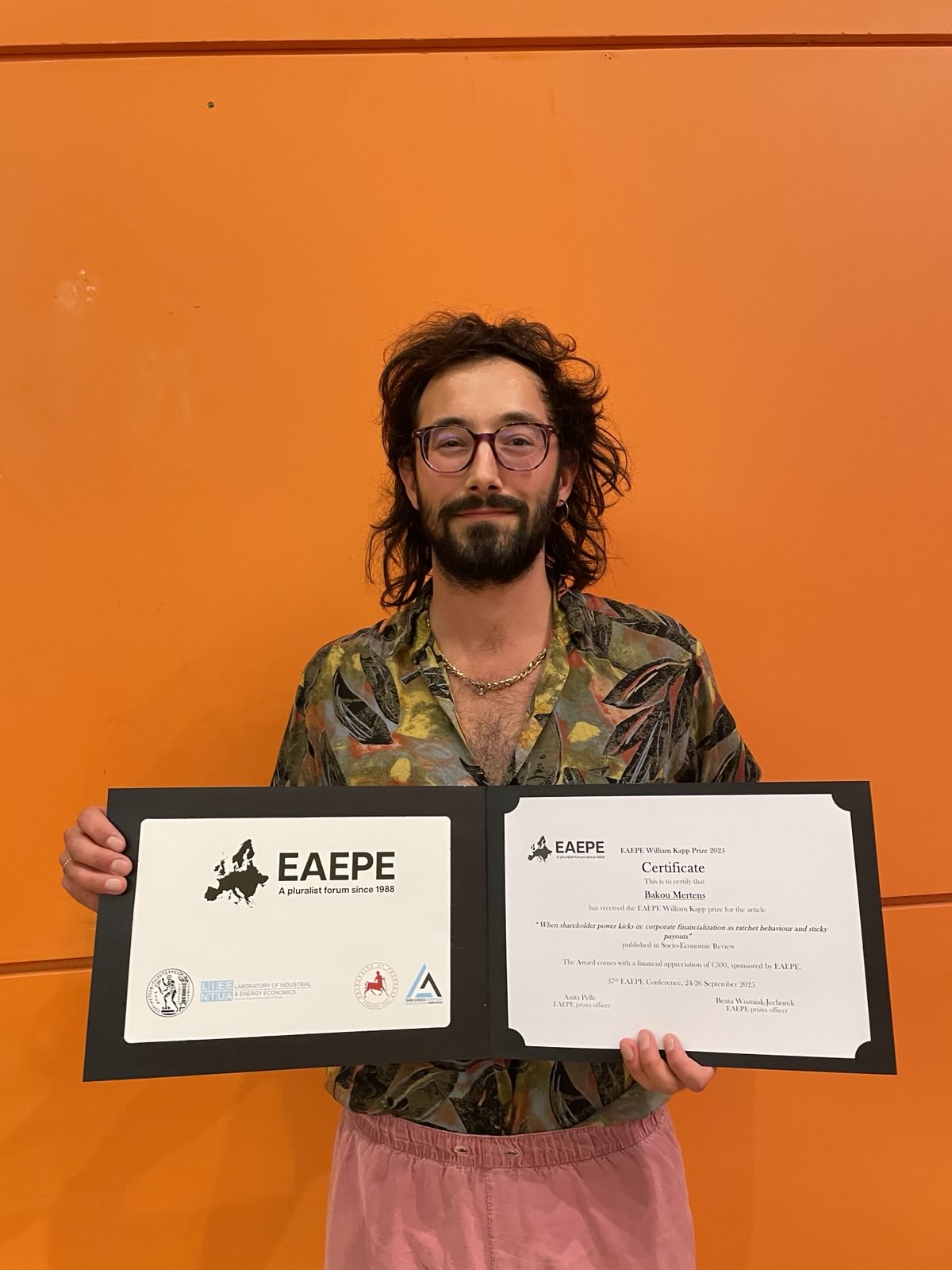
Bakou Mertens
When shareholder power kicks in: corporate financialization as ratchet behaviour and sticky payouts
The paper investigates corporate financialization, specifically how shareholder value orientation (SVO) impacts companies’ payout behaviors. The author argues that rising payout ratios are not primarily due to “shareholder exuberance” during profitable times, but rather a phenomenon called “ratchet behavior”, where shareholders resist reductions in payouts even when profits decline. Through an extensive analysis of global stock-listed firms from 1985 to 2023, the study demonstrates that these “ratchet events” lead to persistently higher payout ratios for over a decade. The research employs various econometric methodologies, including staggered difference-in-differences, to establish a causal link between this downward rigidity in payouts and the observed increase in payout ratios, suggesting it is a key mechanism of SVO in practice.
From the reviews: This paper makes an original and significant contribution to the literature on financialization by introducing a nuanced, firm-level perspective and the novel concept of “ratchet behavior” to explain the persistence and rise of corporate payouts. Its analysis, based on comprehensive global data of all stock-listed firms, clarifies how shareholder value orientation operates across business cycles and firm sizes, thereby enhancing understanding of corporate behavior beyond aggregate generalizations. The study is methodologically rigorous, well-designed, and accessible, combining quantitative robustness with qualitative insights. The paper nonetheless represents a highly innovative and engaging contribution that embodies the heterodox and critical spirit recognized by the EAEPE perspective.
Community and informal institutions in reforms under crises: the odyssey of a 350-year-old functionally credible water commons paper
The paper examines the complex interaction between formal and informal institutions, particularly in the context of reforms initiated during times of crisis. It highlights how top-down, standardized policies often fail when they neglect long-established, local, and functionally effective informal institutions. Focusing on the Stagiates community in Greece, the paper details their decade-long struggle to maintain self-governance over their 350-year-old water commons against a 2010 administrative reform that threatens to dismantle it.
From the reviews: The paper offers a well-grounded theoretical framework and an engaging, well-documented case study of water provision in a small Greek city, creatively applying Historical-Institutional Analysis and Ostrom’s Social-Ecological System framework. Its focus on institutional change and governance of water as a commons aligns closely with EAEPE’s perspectives, and the methodology demonstrates originality in combining local surveys with broader institutional analysis. The paper provides valuable insights into institutional dynamics, making it a relevant and thought-provoking contribution to heterodox political economy.

